In this section, you will find out more about our student services and support programs.
Guidance Officers are employed by the Department of Education to assist students and their families. Guidance Officers are registered teachers with appropriate post-graduate qualifications.
Guidance Officers can help students in several different areas:
- Academic: subject selection. applying for tertiary courses, improving study skills, managing time, exam preparation and career pathways
- Work: characteristics of jobs, opportunities available, developing a suitable career path, applying for jobs, apprenticeships and traineeships
Contact details for Guidance Officer:
- Tash Sankey-Laidlaw
- Phone: 40684555
- Email: nsank2@eq.edu.au
Flexispace
Our Tully SHS Flexispace program is called “FLEX". Tully SHS is offering FLEX to Year 9 students who will benefit from a personalised, flexible learning environment. We launch our program in Term 2 with a trial class of 15 year 9 students who will study English and Maths within this room during their regular lesson times. These students will access the same curriculum in English and Maths as their peers and attend all other subjects with their peers.
A data-informed approach utilising attendance, academic, behavioural and engagement data was used in combination with Teacher, Support Staff and Leadership feedback to identify students with low incidents of behaviour, fairly regular attendance, at least one failed subject and demonstrating difficulties engaging when at school.
FLEX lessons will be delivered using a trauma-informed, strength based, relational approach, focusing on creating a sense of belonging and safety in the classroom, utilising Doug Fisher and Berry Street literature and strategies. Students will work with their teachers and families to develop their own personal goal, (for example, confidence, academic, stress management/self-regulation, attendance), which will be a key focus during the program. Towards the end of Term 2, students will review their progress towards their identified goal and together, with their teacher, identify any further supports required to continue with their progress back into their mainstream classroom in Term 3.
School-Based Youth Health Nurse
The School-based Youth health Nurse works with the school community to promote health and wellbeing, create a supportive, healthy school environment and connect people with other support services.
The Youth Health Nurse can provide students with information about:
- healthy eating and physical activity
- feeling unhappy or stressed
- relationships
- healthy skin
- sexual health
- smoking, alcohol and other drugs
- personal and family problems
- growth and development.
Contact details for the School-based Health Nurse:
- Katrina Wilson - Clinical Nurse
- Cassowary Area Community Health
- Phone: 4068 4555
Confidentiality
Young people have a right to confidentiality when accessing health services. As a health service provider, the Youth Health Nurse respects this but there are some things which the nurse must refer or act upon. Please discuss what can be expected regarding confidentiality with the Youth Health Nurse.
Youth Support Coordinator
The Youth Support Coordinators (YSC) provide a confidential service to young people who are at risk of disengaging or who have recently disengaged from education.
Youth Support Coordinators work closely with young people on a voluntary basis and in conjunction with a range of Community agencies, and can make referrals to access the most appropriate support services. They can provide information, support, advocacy and referrals to young people who may be experiencing a range of issues that are impacting their engagement.
The Youth Support Coordinator can help students in several different areas:
- School attendance
- Financial barriers or difficulties
- Accommodation or housing difficulties
- Relationship issues
- Family conflict or changes
- School related issues
Youth Support Coordinators aim to support young people to remain engaged in education, or transition into other training or employment.
Youth Support Coordinators also facilitate group work and community programs in partnership with the school and other community support agencies to ensure that the emotional and social support needs of young people and their families are addressed.
Contact details for Youth Support Coordinator:
- Thierrine Bromley
- Phone: 40684588
- Email: tbrom52eq.edu.au
Community Education Counsellor
The Community Education Counsellor (CEC) provides educational counselling and support services to Aboriginal and/or Torres Strait Islander children and students. They participate in the development of activities, in and out of school, likely to enhance the involvement in education of Aboriginal and Torres Strait Islander students and their families.
The CEC develop and undertake support service programs designed to meet the needs of the school/s that will encourage the educational participation of Aboriginal and/or Torres Strait Islander children and students and establish and maintain links with out of school sources of information and support services to assist in the advancement of Aboriginal and Torres Strait Islander children and students. They provide information to the school community about Aboriginal and/or Torres Strait Islander social and cultural perspectives and provide advice and information to school administrators regarding Aboriginal and/or Torres Strait Islander social and cultural protocols in order to meet the needs of schools and their communities. They can and participate in activities to develop productive partnerships between members of the school community.
Contact details for the Acting Community Education Counsellor:
- Tegan Muriata
- Phone: 40684539
- Email: tmuri12@eq.edu.au
Social Worker
The Social Worker undertakes individual and group counselling with students, parents and families to assist them in resolving personal or relationship concerns and they provide professional social welfare assessments, interventions and follow up support to students, parents/carers and individuals as required. The identify needs and participate in the referral and planning of services for children, parents and families to community agencies such as health and welfare.
The Social worker develops and implements strategies to provide information, support and encourage awareness of, and participation by, parents/carers and the community in school activities and programs and acts as the contact for parents/carers and the community to determine relevant issues for improved relationships between the school and community.
Social Worker Placemat
Contact details for the Social Worker:
- Cathy Cavallaro
- Phone: 40684501
- Email: ccava91@eq.edu.au
School Chaplain
Our School Chaplain's main role is providing the school community with social, emotional and spiritual support. This includes providing pastoral care and personal support for students, staff and parents. Students can self-refer or be referred by the student support team, teaching staff or parents for individual support sessions. If ongoing support is deemed necessary, parental consent is required and a form will be sent home. I support the whole school community regardless of people's religious background, beliefs and values. You can contact the School Chaplain on Monday and Wednesdays.
Contact details for the School Chaplain:
- Stephen Kersnovske
- Phone: 40684539
- Email: skers36@eq.edu.au
Learning and enrichment
The Learning and Enrichment Team promotes inclusive practices within the Tully SHS learning community, helping all students to successfully access the curriculum and participate in the life of our school.
At enrolment, the educational needs and support processes are identified for students who are:
- diagnosed with disabilities
- diagnosed with a learning difficulty
- experiencing learning differences related to literacy and numeracy
- experiencing social emotional disorders and behavioural difficulties
- from diverse cultural and linguistic backgrounds for whom English is an additional language or dialect (EAL/D).
Contact details for the Head of Special Education Services:
- Lauren Jarvis
- Phone: 40684582
- Email: ljarv26@eq.edu.au
Positive Behaviour for Learning (PBL)
What is PBL? 
Schoolwide Positive Behaviour for Learning (PBL) is a framework for creating safe and orderly learning environments in schools, while improving the social-emotional outcomes for students. It is a proactive approach that relies on research-based practices, including developing clear behavioural expectations, teaching these expectations, acknowledging appropriate behaviour, consistently correcting inappropriate behaviour, and using behavioural data to systematically solve problems. PBL is built on a multi-tiered system of support model that provides additional behavioural supports to students who are not responding to universal or Tier 1 interventions.
What is PBL at Tully State High School?
Students of all ages learn best when the school that they attend has a safe, supportive and disciplined environment. For this reason, Tully State High School is one of many schools in Far North Queensland that uses the School wide Positive Behaviour for Learning (SW-PBL) framework to develop a whole-school approach to student discipline. At Tully State High School, we are committed to delivering the best curriculum to all our students in an inclusive and supportive manner. We seek to build engagement, confidence and resilience in our students. We develop caring relationships, we have high expectations and we build success. Our school offers a variety of pathways to further education, or to work, and seeks to expand our relationships with and within the community. PBL aligns with our Student Code of Conduct 2025-2027 which can be found on our Tully State High School website.
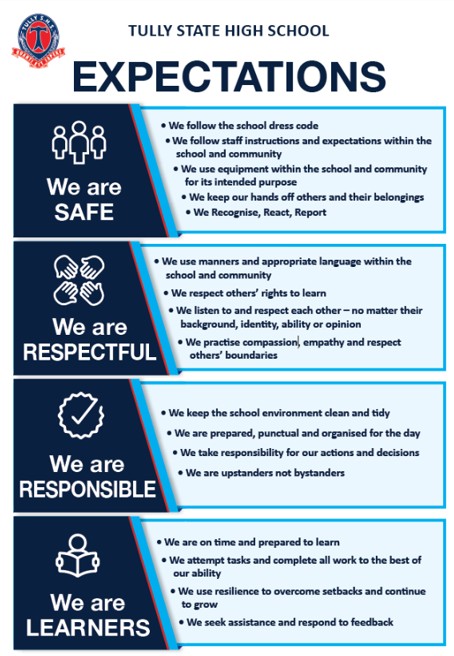
School-wide Expectations
![]()